The last thing a handover team needs is a request for “the missing certificate” with no agreement on which system it covers, who issued it, whether it is current, or whether it should exist at all.
The immediate work can be late recovery, followed by the discovery that part of the question needs inspection, testing or competent advice.
Start by classifying the evidence gap, assigning the next action and separating the questions that require a competent person’s judgement.
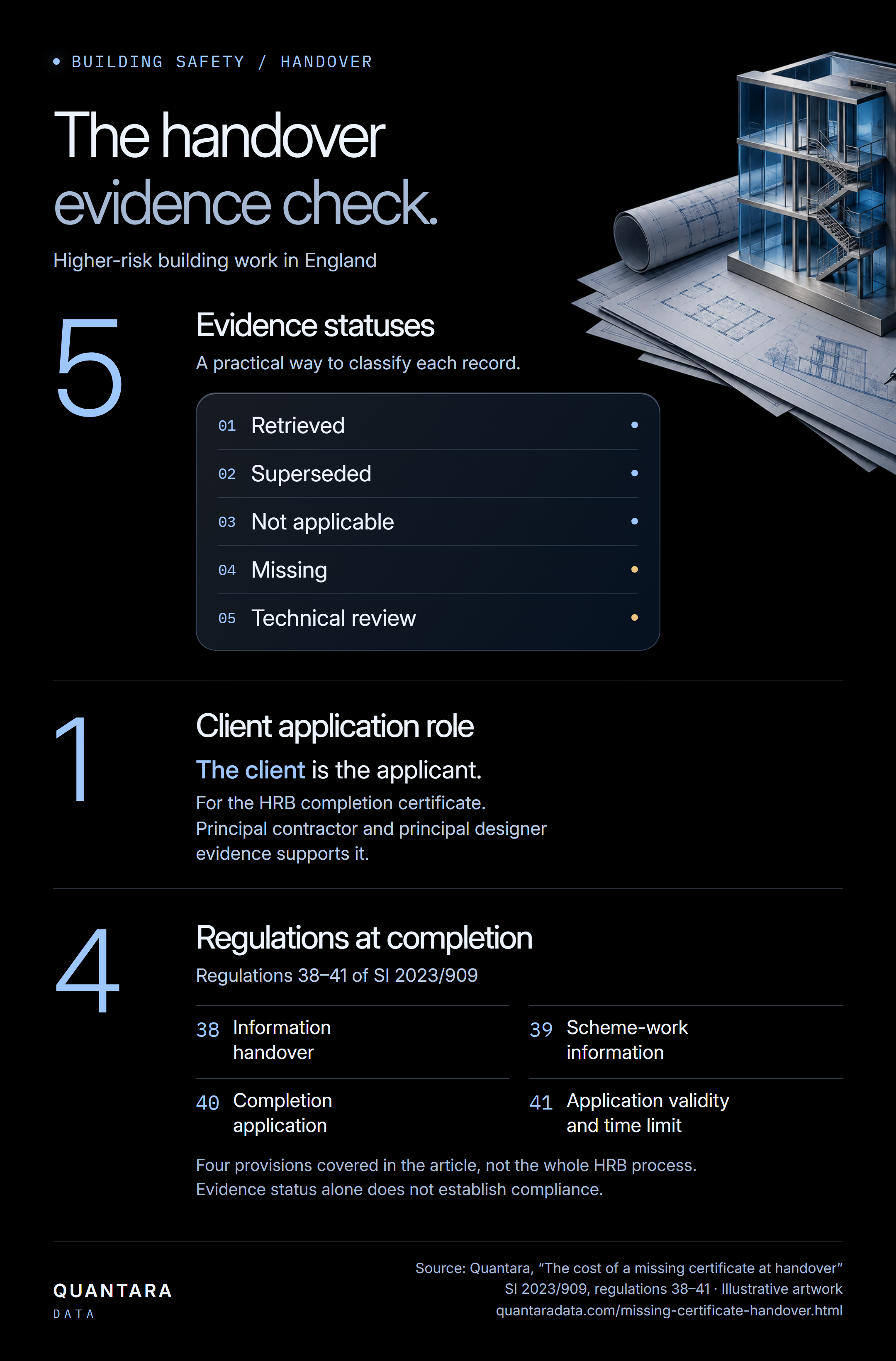
- 5 statusesretrieved, superseded, not applicable, missing or technical review
- 1 ownerfor every material gap and next action
- 4 sourcesBuilding Safety Regulator guidance and England HRB regulations
The certificate is missing. What, exactly, is the problem?
“Missing” is a poor status. It hides several different situations that need different responses.
The item may be present and retrievable, superseded by a later version, not applicable to the relevant work, held by a subcontractor or former project team, or awaiting technical review.
That distinction matters. A certificate with no asset or work-package link, issue date, issuing party or version is hard to use under pressure. The answer is not automatically another chase. First establish what the record was expected to evidence, whether that expectation is still valid, and who should be able to answer.
An absent document is not, by itself, proof of a defective installation. Equally, a document being found does not prove that the work remains suitable or compliant. The record may point to the next technical action. It cannot make that decision.
Why the scramble costs more than the file
Late evidence recovery starts badly because the request is usually too broad. Teams search inboxes, old folders and supplier records in parallel, without a shared view of the system, change or item actually needed.
For higher-risk building work in England, the Building Safety Regulator expects the construction-control plan to set out what evidence will be collected, how it will be collected and who is responsible. Its guidance also requires controlled changes to be recorded with the affected document, revised version and compliance explanation. The same delivery discipline helps even where the statutory process does not apply.
Connect an evidence item early to its asset, work package, change and owner, and it is easier to retrieve at the end. Without that link, recovery may mean repeat enquiries, reopening change history and technical escalation.
That is an operational inference, not a universal cost figure. Sorting records does not inspect an installation, issue a certificate or establish compliance. It makes the remaining work visible sooner.
For England HRB work, handover information has a stricter statutory role
England higher-risk-building work only. The following process is not the rule for every UK project or every type of handover.
For higher-risk building work, including work to an existing higher-risk building, the client must give specified building information and golden-thread information to the relevant person by completion. Where the partial-completion route applies, the timing can instead be tied to occupation of the relevant part. The relevant person depends on the building and the work.
The regulations do not describe a loose pile of attachments. The handover must retain its filing structure, associated indexes, keys and logically associated information. It must be in a format that enables the recipient to read, keep and update it. The recipient must acknowledge receipt and, in the prescribed process, confirm access and that the information is sufficient to understand, operate and maintain the building and its fire-safety systems.
The recipient gives that confirmation, not the team that sorted the files. It explains why a usable index, clear access route and version context matter at the end of a project.
The BSR describes the golden thread as digital information that is secure, available when needed and presented so it can be used. During design and construction, the client’s record system should give users version control, while the principal contractor keeps building information up to date and holds evidence that work meets building regulations.
A missing declaration or record is not a shortcut to a conclusion
For England HRB work, it is the client who applies for the completion certificate. The application needs an as-built description, a client statement on building-regulations compliance, prescribed declarations and a set of supporting plans, logs, statements and files. Principal-contractor and principal-designer evidence may feed that application, but neither is the applicant.
A gap can create correction work. If an application does not meet the regulation 40 requirements, the regulator must notify the applicant that it is invalid and give reasons. Yet it is wrong to say that every missing item makes an application impossible. Where a client cannot secure a required declaration from the principal contractor or principal designer, the regulations provide for the client to explain why it has not been provided.
Contractual practical completion, a building-control completion certificate and occupation are different matters. A tidy folder does not settle any of them. Nor does it discharge the principal accountable person’s continuing responsibility to manage building-safety risks or remove the need for competent help where that is required.
Make the next handover review a triage exercise
This is operational guidance, not a statutory checklist or a substitute for technical review.
- Register the request. Record the item sought, asset or work package, issuer, issue date, version, expected owner, status and location.
- Use a useful status. Separate retrieved material from superseded, not-applicable, genuinely missing and technical-review items.
- Connect it to the work. Link each item to the relevant plan, change, log entry, system or work package. A filename alone is rarely enough.
- Assign one owner and next action. The action may be to retrieve a record, clarify scope, obtain a replacement, arrange inspection or testing, or seek competent advice.
- Hand over something people can use. Give the recipient a readable index and access route. Obtain its acknowledgement where the process requires it.
The aim is a clear view of what the project knows, what it does not know, and who is responsible for finding out.
A handover record set only helps when the receiving team can use it.
For practical next steps, see golden thread handover packs, building-safety compliance certificates and golden thread data management.
A handover record set only helps when the receiving team can use it.
Quantara Data structures and indexes supplied digital records so teams can find, classify and hand over usable information. Dutyholders and competent professionals retain the technical, regulatory and legal decisions.
Sources
- Building Safety Regulator, “Keeping information about a higher-risk building: the golden thread”, GOV.UK, updated 18 September 2024. Supports: digital, secure, usable and version-controlled building information; principal-contractor evidence and record-management responsibilities; end-of-construction golden-thread context.
- Building Safety Regulator, “Preparing information for a building control approval application”, GOV.UK. Supports: construction-control-plan evidence collection and responsible collectors; controlled-change and change-control-log information.
- The Building (Higher-Risk Buildings Procedures) (England) Regulations 2023, SI 2023/909, regulations 38 to 41. Supports: HRB handover timing, filing structure, recipient acknowledgement and format; completion-certificate application requirements, client role, validity and missing-declaration route.
- Building Safety Regulator, “Safety in high-rise residential buildings: accountable persons”, GOV.UK, updated 18 September 2024. Supports: principal accountable person’s ongoing safety duties and competence requirements.